
Tangipahoa Parish Criminal Court Records
The Tangipahoa Parish Clerk of Court Criminal Department files formal charges from the 21st Judicial District Attorney. The department handles felony charges and misdemeanor charges that occur outside municipal court city limits. It also issues criminal subpoenas, criminal and civil bench warrants, files extradition papers, sends notice of judgment to bondsmen, maintains affidavits for judgments, expunges criminal records, conducts criminal background searches, and files criminal pleadings.
The court level matters. Tangipahoa Parish is part of the 21st Judicial District Court, which also serves Livingston and St. Helena Parishes. The 21st JDC states that it has original jurisdiction over civil and criminal matters in the district. Louisiana also has city courts, mayor's courts, and justice of the peace courts, so a city-limit misdemeanor or municipal traffic case may require a lower-court check. For the charging path before the full case record, see Tangipahoa Parish arrest records and court charges.
Louisiana's court structure comes from Louisiana Constitution Article V, which creates the supreme court, courts of appeal, district courts, and other authorized courts.
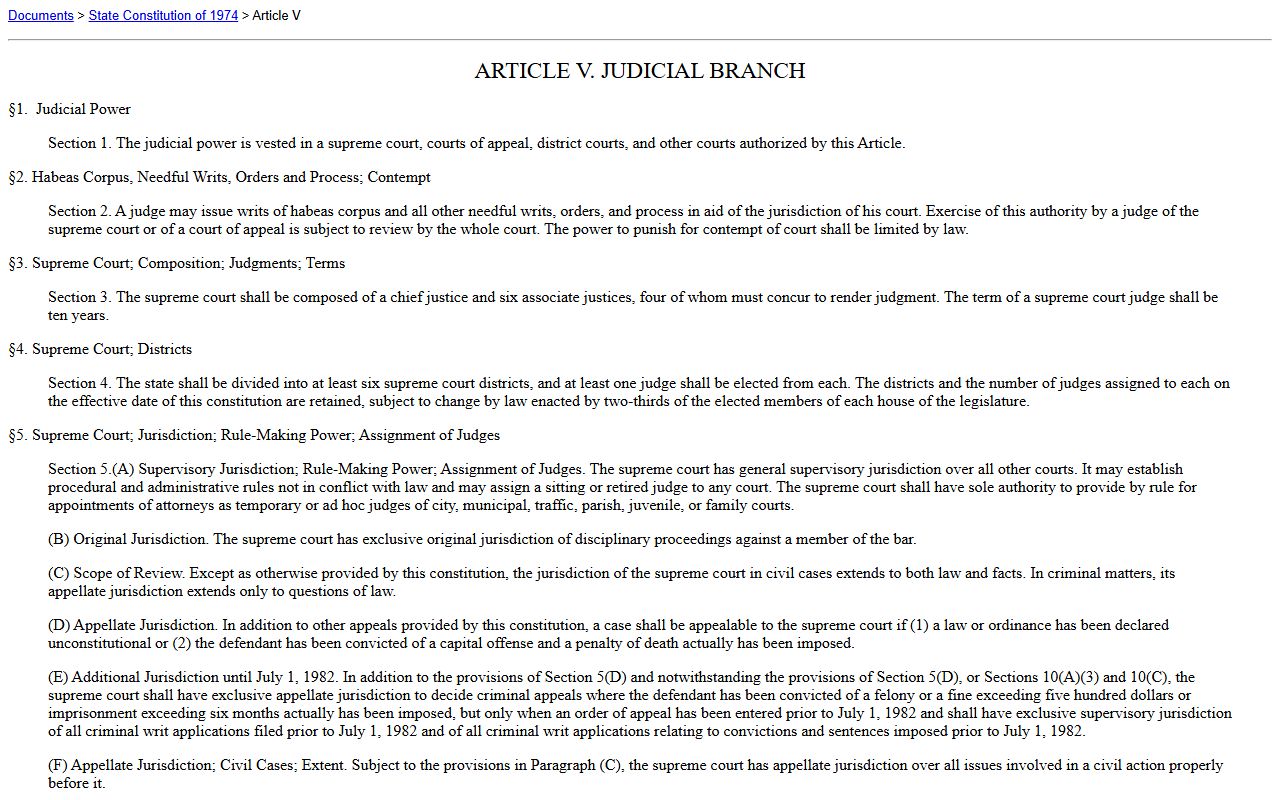
That statewide structure explains why Tangipahoa Parish criminal court records are filed in the district-court system while some local matters can remain in city or municipal courts.
Search Tangipahoa Parish Criminal Records
The Clerk's Criminal Record eSearch page is the main online starting point for Tangipahoa Parish criminal court records. The service uses Clerk Connect and has subscriptions of $20.00 for 24 hours, $40.00 for 30 days, or $300.00 for one year. Printing is $1.00 per page. Certified copies online cost $10 per document plus the page fee. The Clerk also lists a $20 criminal history verification by phone.
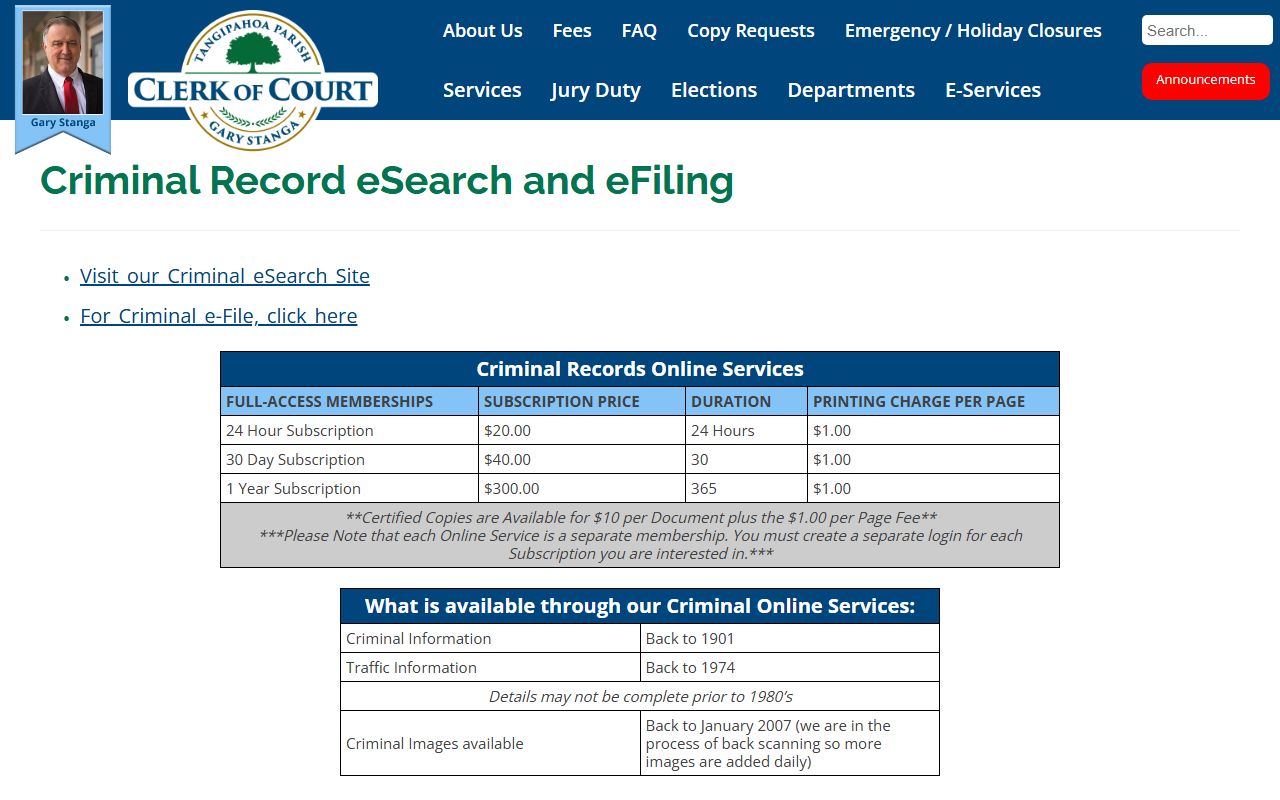
Criminal Record eSearch is the correct online channel for district-court criminal case research, but it does not erase the need for copy requests when images or older detail are not available.
- Use the Clerk E-Services menu and select Criminal Record eSearch for district-court criminal cases and traffic matters.
- Search with the available account tools after login. The public research confirms the coverage dates but not every hidden field.
- Check the coverage limits. Criminal information goes back to 1901, traffic information goes back to 1974, details may be incomplete before the 1980s, and criminal images go back to January 2007.
- Read the docket and minute activity to distinguish a filed charge from a final disposition.
- Request certified copies from the Clerk when the record must be used for court, licensing, immigration, employment review, or another formal purpose.
When the question is not a document search, use the right office. The 21st Judicial District Attorney's Tangipahoa office is at 110 N. Bay St., Amite, LA 70422, phone (985) 748-7890. District 21 public defender office is at 303 East Oak Street, Amite, LA 70422, phone (985) 748-4922. The public defender office is open Monday-Friday 8:00-12:00 and 1:00-4:00.
Tangipahoa Parish Criminal Case Flow
A criminal court record grows as the case moves through the court. The charge may begin in law-enforcement paperwork, but the court case file begins when the DA files formal charges and the Clerk dockets the case. Later entries can show arraignment, subpoenas, motions, hearings, continuances, pleas, trial settings, verdicts, dispositions, sentencing, bondsman notices, or bench warrants.
Case flow: Charges Filed › Arraignment › Pretrial / Motions › Plea or Trial › Disposition › Sentencing
| Stage | What Happens |
|---|---|
| Charges filed | The DA files formal charges with the Clerk, and the criminal case record opens in the district court system. |
| Arraignment | The defendant is called to answer the charge and enter a plea such as guilty, not guilty, or no contest. |
| Pretrial / motions | The parties file motions, request orders, exchange issues, and set or continue hearings. |
| Plea or trial | The charge is resolved by plea, trial verdict, dismissal, or another court-approved result. |
| Disposition / sentencing | The court records the outcome and, if there is a conviction, the sentence, probation, restitution, fine, or other order. |
Tangipahoa Criminal Court Record Fields
A Tangipahoa Parish criminal court record is more than a list of charges. It can include case-level details, filings, notices, minute entries, court orders, judgment notices, affidavits for judgments, and expungement activity. Traffic citations also appear in the criminal section when they are filed by the Traffic Clerk. Juvenile delinquency, children in need of care, and criminal non-support files are maintained by the Criminal Department, but juvenile proceedings are confidential and not open for ordinary public viewing.
| Field | What It Shows |
|---|---|
| Case number | The criminal docket or case number used by the Clerk and court. |
| Defendant | The person accused in the district-court criminal case. |
| Formal charges | The accusations filed by the DA, including felony charges and non-municipal misdemeanor charges. |
| Minute entries | The Clerk's outline of what occurred during court events. |
| Plea | The defendant's response to the charge, such as guilty, not guilty, or no contest. |
| Warrants | Bench warrants or related process issued by the court for failure to appear or noncompliance. |
| Disposition | The outcome of the case or charge, such as dismissed, guilty, not guilty, or other final action. |
| Sentence | The punishment or court order imposed after conviction, including probation, fines, restitution, or custody terms when recorded. |
Tangipahoa Charges vs Convictions
A charge is an accusation. A conviction is a result after a guilty plea, verdict, or other adjudication that counts as guilt under the case facts. Tangipahoa Parish criminal court records may show charges that were amended, reduced, dropped, dismissed, or resolved in a way that is not a conviction. For broader record types beyond criminal cases, use Tangipahoa Parish court records.
| Charge | Conviction | |
|---|---|---|
| Meaning | A criminal accusation filed or listed in the case. | A court outcome based on a plea, verdict, or adjudication. |
| Where it appears | Formal charges, docket entries, charging documents, and amended charge lists. | Disposition, judgment, sentence, probation order, or final minute entry. |
| Can change | Yes. It may be amended, reduced, dismissed, or nolle prosequi. | It changes only through lawful post-judgment action, appeal, correction, or expungement limits. |
| Use caution | Never treat a charge alone as proof of guilt. | Still check for appeal, expungement, set-aside effect, or later court orders. |
Sealed Tangipahoa Criminal Court Records
Sealed records and expunged records are not the same. A sealed record is closed to public view because a statute or court order restricts access. An expungement removes a record from public access without destroying it. The Clerk Criminal Department states that it expunges criminal records, and Louisiana State Police processes court-ordered expungements when criminal-history records need modification.
Louisiana Code of Criminal Procedure Article 971 defines the effect of an expungement.
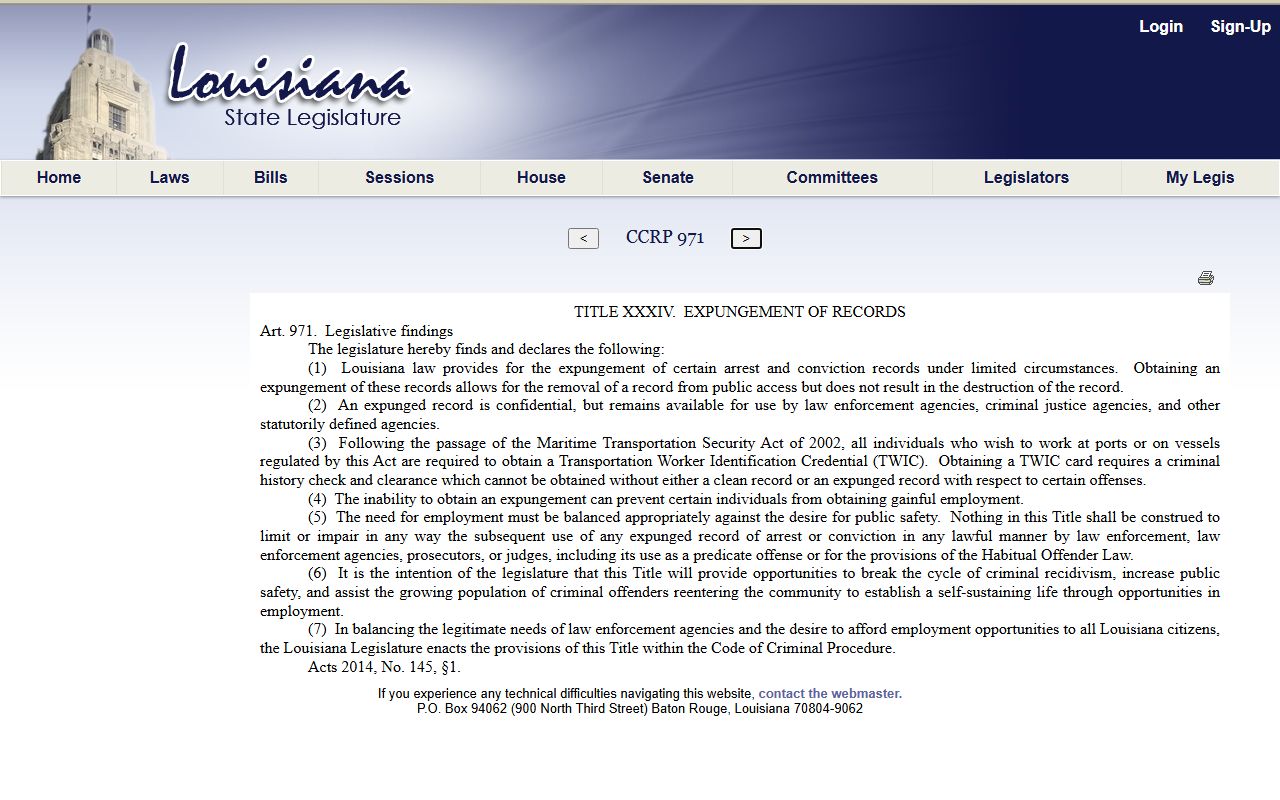
The statute is important because it makes clear that expungement removes public access but does not destroy the record.
The Louisiana State Police expungements page is the state-level agency source for criminal-history modification after a court order.
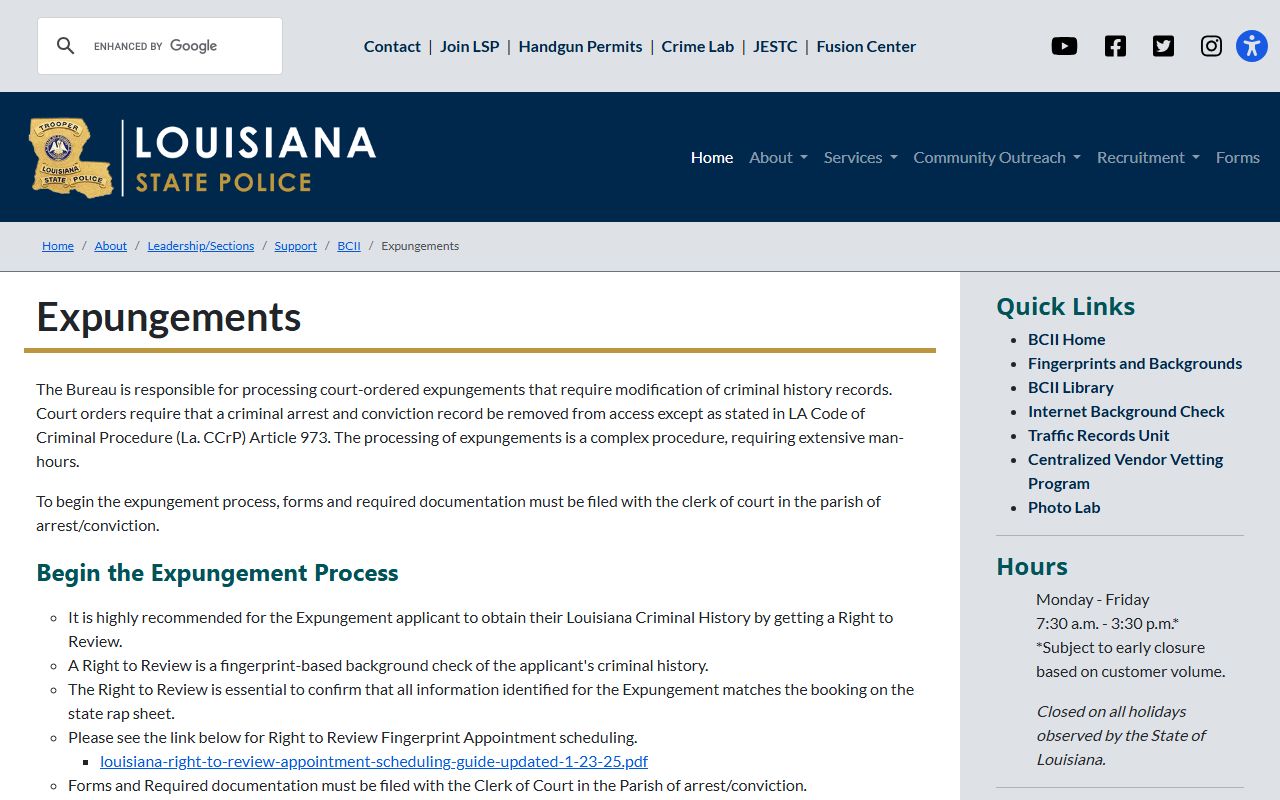
For Tangipahoa Parish cases, the court order starts locally, while the state agency handles records under its control.
| Sealed | Expunged | |
|---|---|---|
| Public visibility | Closed from ordinary public view by law or court order. | Removed from public access after an expungement order. |
| Record status | The record still exists. | The record still exists and is not destroyed. |
| Access after restriction | Usually requires a valid court order or statutory authority. | Law enforcement and defined agencies may still have access under Louisiana law. |
Access Tangipahoa Criminal Court Records
Public access to Tangipahoa Parish criminal court records begins with Louisiana Public Records Law and the Clerk's role as custodian. Louisiana R.S. 44:31 recognizes the right of adults to inspect, copy, or reproduce public records unless an exception applies. Louisiana R.S. 44:32 governs custodian access procedures. Those access rules operate alongside court confidentiality rules, sealed orders, expungement law, and juvenile restrictions.
Louisiana Code of Civil Procedure Article 253 also matters because electronic filings cannot include certain sensitive identifiers.
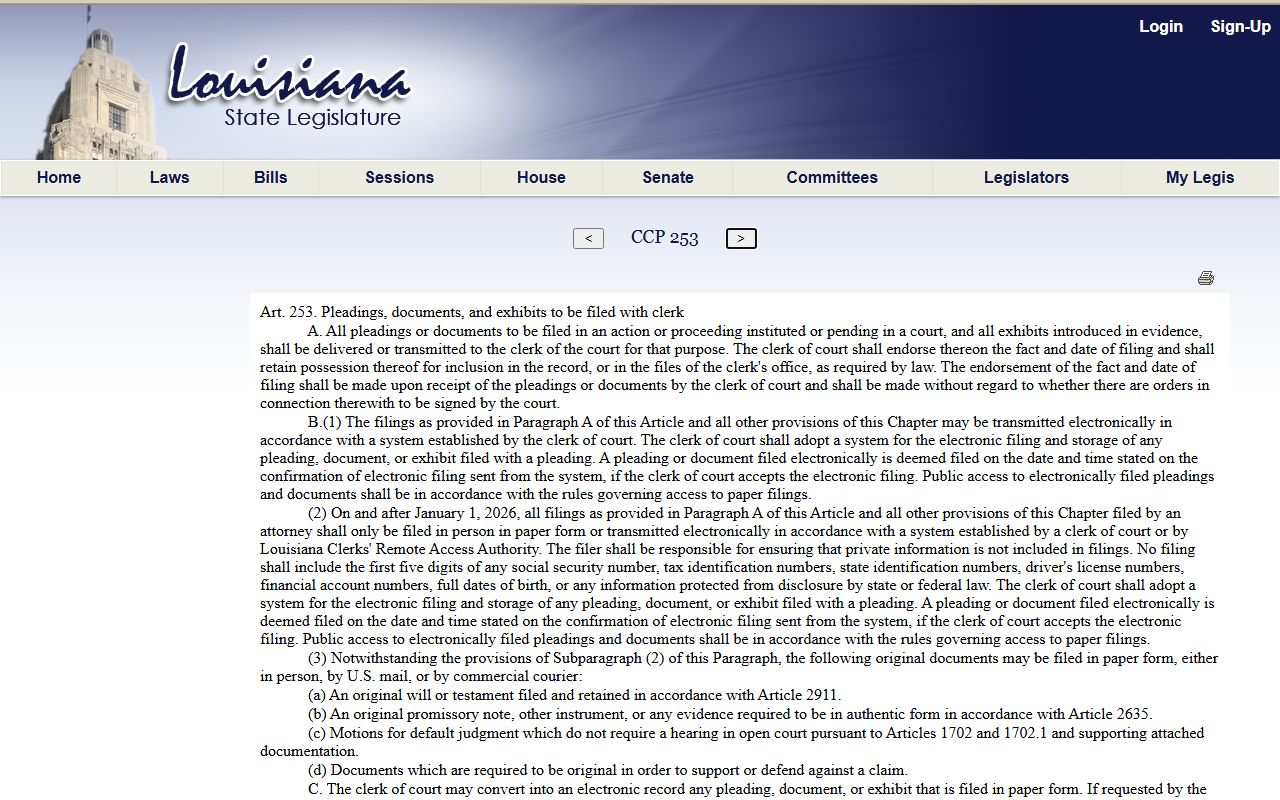
Redaction rules protect items such as Social Security number digits, financial account numbers, full dates of birth, and protected information that should not appear in public filings.
Note: The Clerk may provide public criminal case access, but sealed, expunged, juvenile, and protected-identifier content is not open in the same way.
Restricted Tangipahoa Criminal Court Records
Juvenile records require special caution. The Clerk states that all juvenile proceedings are confidential and cannot be viewed by the public without a valid court order. Louisiana Children's Code Article 412 makes juvenile records and reports confidential except as authorized.
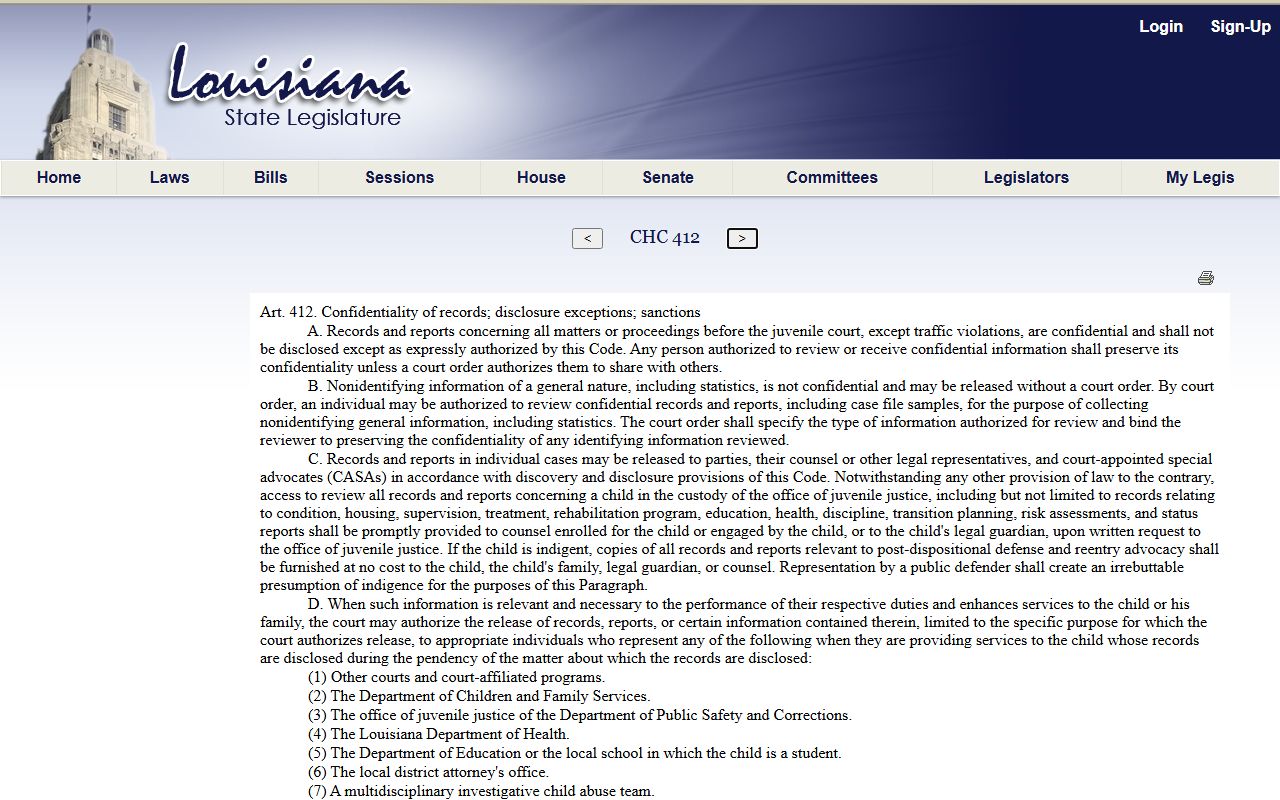
That restriction applies even though the Criminal Department maintains juvenile delinquency, children in need of care, and criminal non-support files.
Other restricted criminal court records can include sealed cases, commitment records, protected personal identifiers, expunged records, and records withheld because a specific statute or court order controls access. A public search may show that a case exists while withholding documents, or it may remove the case from public access after a valid expungement order. The Copy Department can release confidential and sealed records only with issuance of a signed court order by a judge.