
Tangipahoa Parish Arrest Records
Arrest records and court charge records answer related but different questions. The arrest side is created by law enforcement when a person is arrested, booked, held, released, or listed on the jail roster. The charge side begins when the 21st Judicial District Attorney screens the incident and files formal charges with the Clerk of Court. The Clerk's Criminal Department files those DA charges, issues criminal subpoenas, issues bench warrants, files extradition papers, handles expungements, and maintains criminal pleadings.
The Tangipahoa Parish Sheriff's Office is the local law-enforcement and jail agency. TPSO lists Sheriff Gerald Sticker, the parish contact address at 15475 Club Deluxe Road, Hammond, LA 70403, phone 985-345-6150, Amite phone 985-748-8147, and office hours Monday-Friday 8 AM-4 PM. Booking and custody detail belongs with TPSO and the jail roster. The filed court case and later outcome belong with the Clerk and the 21st JDC. For the complete case record after filing, use Tangipahoa Parish criminal court records.
Find Tangipahoa Parish Arrest Records
The official web custody path is the TPSO Jail Guide and public roster. The jail guide says the roster includes current inmates, released inmates, charges, and relevant incarceration details. The roster results observed in research included sort controls, search and clear controls, pagination, and fields for name, inmate ID, date of birth, race/gender, booking date, and a view link. Booking detail can include arresting agency, fugitive hold, charges, counts, bond, and a court-date field that may be blank.
The TPSO jail roster is the successful manifest source for booking-side arrest information.
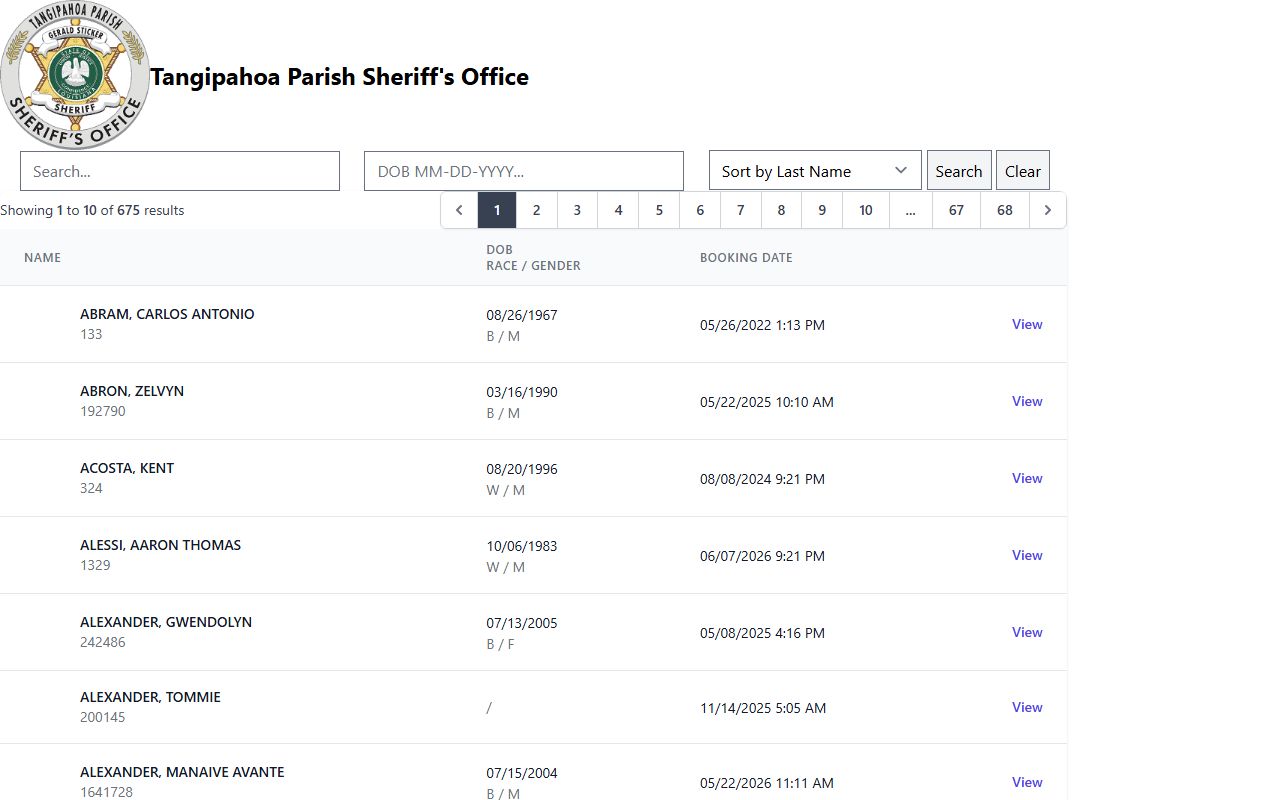
The roster can help locate custody and booking details, but it is not the full court charge record and may not list every active warrant or all later case activity.
- Search the TPSO roster for booking and custody status when the person may be in or recently released from parish jail.
- Record the name, inmate ID, booking date, arresting agency, listed charges, count, bond, and any court-date field shown.
- Move to the Clerk Criminal Record eSearch or Criminal Department for formal charges filed by the DA.
- Check the DA docket page or court when the issue is an upcoming appearance, missed court, or bench warrant.
- Use Louisiana VINE or DOC channels for state custody, prison, probation, or parole status that is not shown on the parish roster.
For custody and roster detail beyond this arrest-to-charge path, use Tangipahoa Parish inmate records.
Charges After Arrest
After an arrest, the court charge record depends on prosecutor action. The 21st Judicial District Attorney's Office, led by Scott M. Perrilloux, prosecutes cases in Livingston, St. Helena, and Tangipahoa Parishes. Its Tangipahoa Parish office is at 110 N. Bay St., Amite, LA 70422, phone (985) 748-7890, and office hours are Monday-Friday 8:00 a.m. to 4:00 p.m. When charges are filed, the Clerk Criminal Department records the formal charges in the district-court case.
| Document Type | Who Starts It | How It Functions |
|---|---|---|
| Complaint | Law enforcement or prosecutor, depending on procedure. | States the alleged offense and can support the first charging path after arrest. |
| Bill of information | Prosecutor. | A DA-filed charging document used for many Louisiana criminal cases. |
| Indictment | Grand jury. | A formal grand-jury accusation, commonly tied to more serious felony prosecution. |
A booking charge and a filed charge can differ. The jail roster may show what was used at booking or what was active at the time of custody. The court charge record shows what the DA filed, amended, reduced, dismissed, or took to plea or trial.
Tangipahoa Parish Charge Status
Charge status changes as the case moves. A person may be arrested on one charge, booked on several lines, and later prosecuted on fewer, different, or amended charges. The Clerk's criminal records and minute entries are the better source for filed charge status, while the roster is a custody snapshot. A docket entry may also show whether a charge led to a plea, dismissal, bench warrant, judgment, or sentence.
| Status | What It Means |
|---|---|
| Pending | The charge is still open and has not reached a final disposition. |
| Amended | The filed charge changed, often because the prosecutor revised the allegation or statute. |
| Reduced | The charge changed to a lower or less severe offense. |
| Dismissed | The court record shows the charge was dismissed and did not proceed to conviction on that count. |
| Nolle prosequi | The prosecutor chose not to pursue that charge, subject to the limits of the specific case and law. |
| Disposition entered | The record has an outcome such as guilty plea, trial verdict, dismissal, or other final action. |
Charges vs Convictions
A court charge after arrest is not proof of guilt. It is an accusation filed or tracked in the case. A conviction is a result after a guilty plea, verdict, or other qualifying court action. Tangipahoa Parish charge records can show charges that were later dismissed, amended, reduced, or not pursued. That distinction is central when reading arrest records, because booking data may continue to show a charge line even when the later court file took a different path.
| Charge | Conviction | |
|---|---|---|
| Record stage | Appears after arrest, booking, DA filing, or amendment. | Appears after plea, verdict, or final adjudication. |
| Meaning | An accusation that must still be proved or resolved. | A court outcome that establishes guilt under the case result. |
| Can disappear from public view | May be sealed, restricted, dismissed, or expunged from public access when law allows. | May be subject to appeal, correction, or expungement limits depending on Louisiana law. |
| Best source | Roster for booking detail, Clerk record for filed charge status. | Clerk criminal case file, disposition, judgment, and sentencing entries. |
Statewide Custody and Charge Checks
Not every post-arrest status stays in the parish jail roster. The research documents Tangipahoa LAVNS, Louisiana VINE, and Louisiana Department of Corrections inmate information as fallback channels. VINE is for custody and criminal-case notification, not a full district-court file. DOC says people in DPS&C custody can be located through LAVNS, with updates every 24 hours, and that it includes prison, probation, and parole supervision data.
The successful manifest source for statewide notification is Louisiana VINE.

VINE helps with custody and notification questions, but formal court charges and dispositions must still be checked through the Clerk or court record.
The successful DOC manifest source is the Louisiana Department of Corrections inmate information page.
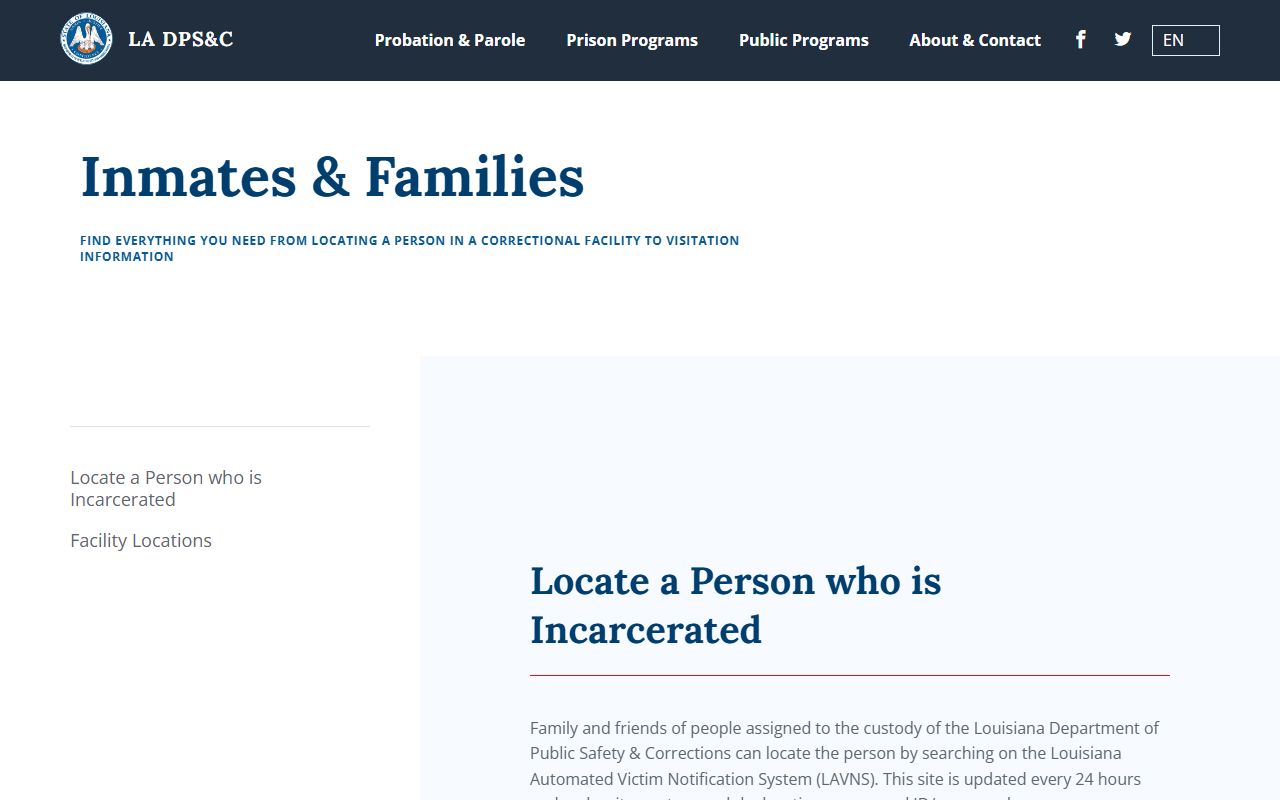
DOC access is most relevant after a person moves from parish custody into state custody or supervision.
Warrants After Arrest
A warrant can appear before or after an arrest. The research did not locate an official TPSO public active-warrant list, so the fallback chain matters. The Clerk Criminal Department issues criminal and civil bench warrants. The Traffic Clerk records minute entries and issues bench warrants. A missed court date, unpaid traffic obligation, missed probation requirement, restitution problem, drug court fee issue, or other noncompliance can lead to warrant activity.
For district-court criminal or traffic charges, contact the Clerk Criminal Department at (985) 284-2630 or the 21st JDC Collections office at (985) 284-2108 when payments or traffic obligations are involved. For custody or law-enforcement questions, TPSO can be reached at Amite (985) 748-8147 or Hammond (985) 345-6150. City-limit citations and municipal misdemeanors may require a check with the city or municipal court named on the paperwork.
Public Access to Charge Records
Louisiana Public Records Law supports access to public records through the correct custodian. For court charge records, that is generally the Tangipahoa Parish Clerk of Court. For booking, custody, and law-enforcement arrest material, that is generally TPSO. Louisiana R.S. 44:1 defines public records, R.S. 44:31 recognizes inspection and copy access, and R.S. 44:32 describes custodian duties.
Fees can apply. Criminal eSearch subscriptions are $20.00 for 24 hours, $40.00 for 30 days, or $300.00 for one year. Printing is $1.00 per page. Certified criminal copies online are $10 per document plus the page fee. Criminal history verification by phone carries a $20 criminal history search fee. Plain copy requests through the Copy Department are $1.00 per page, and certification is $10.00.
Restricted Arrest and Charge Records
Some arrest and court charge records are not open to ordinary public search. Juvenile proceedings are confidential, and Louisiana Children's Code Article 412 protects juvenile records and reports except as authorized. Adoptions, commitments, sealed files, and some protective-order material are kept in the Clerk's confidential vault. The Copy Department says confidential and sealed records can be copied only with a signed court order by a judge.
Expungement also changes public access. Louisiana Code of Criminal Procedure Article 971 defines expungement as removal from public access, not destruction. A Tangipahoa Parish criminal expungement begins as a court filing in the criminal case record, and Louisiana State Police processes court-ordered expungements that require criminal-history modification. A jail roster charge may remain visible until the roster updates, while a court record requires a separate expungement order to remove public access.
Important: Arrest records and filed charges should not be treated as convictions unless the court disposition shows that result.